
Introduction
Non-healing ulcers represent one of the most complex challenges in modern clinical practice. Despite advanced wound dressings, prolonged antibiotics, Negative Pressure Wound Therapy (NPWT), and even repeated surgical procedures, many ulcers fail to heal completely.
Such wounds lead to persistent pain, restricted mobility, emotional distress, repeated hospital visits, and in advanced cases, risk of limb loss.
At Dnyan Raj’s TRUE HEALTH CARE, under the expert guidance of Dr. Satish Sawale, chronic ulcers are managed through a structured Ayurvedic healing strategy that addresses not only the wound surface but the internal biological environment essential for true regeneration.
What Is a Non-Healing Ulcer?
A wound is clinically classified as non-healing when it:
- Persists beyond 4–6 weeks
- Shows minimal or no granulation
- Has continuous discharge or infection
- Reopens after temporary closure
- Does not respond to conventional wound care
Such ulcers are not isolated skin problems — they indicate systemic failure of tissue repair mechanisms.
Common Types of Non-Healing Ulcers
1. Varicose Vein Ulcers
Caused by chronic venous insufficiency, these ulcers are characterized by swelling, pigmentation, and persistent ankle wounds due to venous congestion and poor oxygenation.
2. Diabetic Foot Ulcers
Among the most serious chronic wounds in India, diabetic ulcers develop due to neuropathy, impaired circulation, reduced immunity, and high infection risk.
3. Post-Surgical Non-Healing Wounds
(After joint replacement or fracture fixation)
Delayed healing may occur due to tissue ischemia, implant-related inflammation, reduced regenerative capacity, or compromised circulation.
Ayurvedic Perspective: Dushta Vrana
Ayurveda describes chronic non-healing ulcers as Dushta Vrana — wounds that persist due to:
- Accumulation of metabolic toxins (Ama)
- Weak digestion and tissue metabolism (Agni)
- Impaired blood tissue (Rakta Dushti)
- Reduced vitality of muscle and skin tissues (Mamsa Dhatu Kshaya)
- Tridosha imbalance
Unless these internal factors are corrected, external wound management remains incomplete.
Healing Philosophy at Dnyan Raj’s TRUE HEALTH CARE
The guiding principle followed by Dr. Satish Sawale is:
Healing cannot be forced externally — it must be restored internally.
Ayurvedic wound care therefore follows a strategic (root-cause correction) and tactical (local regeneration support) model.
Strategic Healing Approach (Internal Restoration)
1. Internal Detoxification (Shodhana)
Ayurvedic detox therapies help:
- Remove inflammatory toxins
- Improve microcirculation
- Reduce chronic infection tendency
- Support natural internal debridement
This prepares the wound bed biologically rather than mechanically.
2. Metabolic and Immune Correction
Treatment aims to:
- Strengthen digestion and metabolism
- Stabilize blood sugar in diabetic patients
- Improve tissue oxygenation
- Enhance immune surveillance
These factors are essential for sustained healing.
Tactical Healing Approach (Local Regeneration)
Promotion of Healthy Granulation
Ayurvedic formulations support:
- Development of healthy granulation tissue
- Reduction in discharge and odor
- Natural wound edge contraction
- Faster epithelialization
Rasayan Therapy – Regenerative Medicine
Rasayan medicines play a crucial role by:
- Enhancing collagen synthesis
- Improving tissue nutrition
- Strengthening immunity
- Preventing recurrence
They are especially valuable in elderly patients and long-standing ulcers.
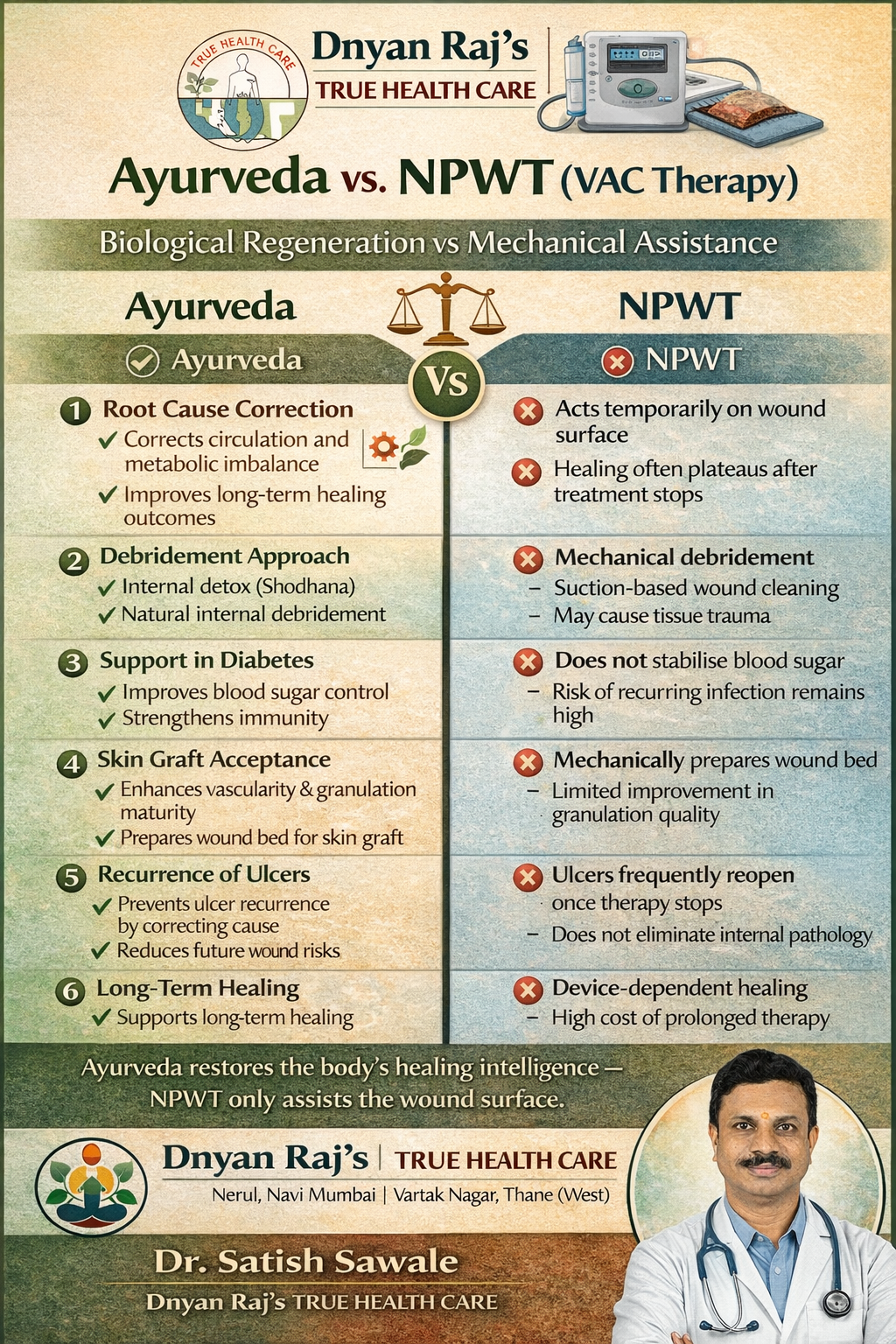
Comparison with NPWT (Negative Pressure Wound Therapy)
Negative Pressure Wound Therapy (VAC therapy) is widely used in modern wound management to remove exudate and promote temporary granulation. While beneficial in selected cases, NPWT has inherent limitations when used alone.
Key Clinical Differences
NPWT focuses primarily on mechanical assistance, whereas Ayurveda focuses on biological regeneration.
Advantages of Ayurvedic Healing:
- Treats root metabolic and circulatory causes
- Enables internal debridement without tissue trauma
- Produces sustainable healing beyond therapy duration
- Provides superior support in diabetic ulcers
- Improves wound bed quality for skin graft acceptance
- Reduces recurrence risk
- Enhances patient comfort and compliance
- Cost-effective for long-term chronic wounds
At TRUE HEALTH CARE, Ayurveda is often used alongside or following NPWT, ensuring deeper healing rather than temporary closure.
Role of Diet and Lifestyle Regulation
Healing is accelerated through:
- Anti-inflammatory, digestion-friendly diet
- Blood sugar–supportive nutrition
- Avoidance of junk, fermented, and excess sweet foods
- Limb elevation in venous ulcers
- Regulated sun exposure
- Adequate sleep and stress control
Diet functions as therapeutic support, not merely nutrition.
Support in Skin Graft and Plastic Surgery Cases
Ayurvedic therapy improves:
- Wound vascularity
- Granulation maturity
- Tissue receptivity
This significantly increases skin graft survival and improves post-surgical healing outcomes.
Clinical Outcomes Observed
With disciplined treatment:
- Pain and discharge reduce steadily
- Granulation improves visibly
- Wound margins contract naturally
- Mobility improves
- Recurrence risk decreases
- Overall quality of life improves
Consultation Locations
Dnyan Raj’s TRUE HEALTH CARE
Under the guidance of Dr. Satish Sawale
 Nerul, Navi Mumbai
Vartak Nagar, Thane (West)
Conclusion
Non-healing ulcers are manifestations of internal imbalance rather than isolated skin defects.
Ayurveda provides a scientific, regenerative, and time-bound healing pathway by restoring metabolism, circulation, immunity, and tissue vitality simultaneously.
When internal healing begins,
the wound follows naturally.